
FPGA vs Microcontrollers — Which One Should You Learn?
If you're an electronics or computer science student in India, you've probably heard terms like “Microcontrollers”, “FPGA”, “VLSI”, or “RTL Design”… and wondered: Which one is better for me? What should I learn? What gives a better career? Let’s simplify.
Eshanav Systems
10/1/20251 min read
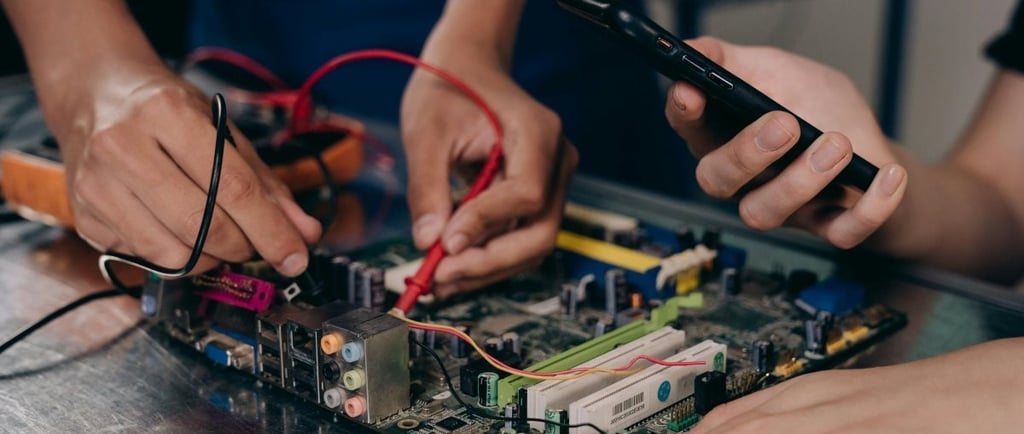
If you're an electronics or computer science student in India, you've probably heard terms like “Microcontrollers”, “FPGA”, “VLSI”, or “RTL Design”… and wondered:
Which one is better for me? What should I learn? What gives a better career?
Let’s simplify.
What Are They?
Microcontroller (MCU):
A small computer with CPU, memory, and peripherals (e.g., Arduino, PIC, STM32)
Programmed using C / Embedded C
Runs step-by-step code
Has fixed architecture
Affordable: ₹50 – ₹5000
FPGA (Field Programmable Gate Array):
A reconfigurable digital logic chip — like building your own processor
Programmed using HDL (Verilog / VHDL)
Runs many operations in parallel
Can be rewired anytime by code
Board cost: ₹2000 – ₹20,000
Where Are They Used?
Microcontroller Applications:
Home appliances: ACs, washing machines, TVs
IoT gadgets: Smart meters, ESP32 projects
Automotive: Wipers, power windows
Hobby projects & Startups: Arduino & Raspberry Pi
FPGA Applications:
5G / Telecom base stations
High-speed video processing & AI accelerators
Aerospace & Defence (DRDO / ISRO)
ASIC prototyping & VLSI pre-silicon verification
Crypto mining & High-frequency trading
Which One Should YOU Learn?
Quick DIY projects / IoT / Robotics → Microcontrollers
Hardware logic, digital circuits, VLSI, processors → FPGA & Verilog
Automotive, IoT, Embedded Jobs → MCU + RTOS + Communication Protocols
Chip Design (Intel / Qualcomm / AMD / TSMC) → FPGA + RTL + SystemVerilog
Career Path Comparison
Microcontroller / Embedded Systems:
Roles: Embedded Developer, IoT Engineer, Firmware Engineer
Salary (Freshers): ₹3 – 6 LPA
Companies: Bosch, Continental, Tata Elxsi, Mahindra, Startups
FPGA / VLSI / RTL Design:
Roles: FPGA Engineer, RTL Design Engineer, Verification Engineer
Salary (Freshers): ₹5 – 12 LPA
Companies: Intel, Qualcomm, AMD, Nvidia, DRDO, ISRO, Tejas Networks
Where to Get Started?
If You Choose Microcontrollers:
Start with Arduino or ESP32
Learn Embedded C, UART/SPI/I2C
Move to STM32 or PIC for depth
Try RTOS + IoT project
If You Choose FPGA:
Learn Digital Electronics basics (MUX, Flip-Flops, FSM)
Start with Verilog or VHDL
Use tools like Xilinx Vivado / Intel Quartus
Buy a Basys3 / Arty / TinyFPGA board
Final Advice
Both fields have scope:
FPGA/VLSI → higher salary, tougher learning curve
MCU/IoT → easier to start, great for projects, startups, freelancing
Pro tip: Start with Microcontrollers to build strong fundamentals. If you enjoy digital logic, move to FPGA & VLSI.
Want Hands-On Training?
We offer Internship Programs in Embedded Systems & VLSI/FPGA Design — tailored for Indian students, with project-based learning + career guidance.
Visit: https://learn.eshanavsystems.in/
Welcome
Registered Office:
Innov8 Mantri Commercio Tower A,5th Floor, No. 51, Devarabisanahalli, Bengaluru- 560103
Connect
eshanavtech@gmail.com
+91- 94819 30885
© 2025. All rights reserved.